
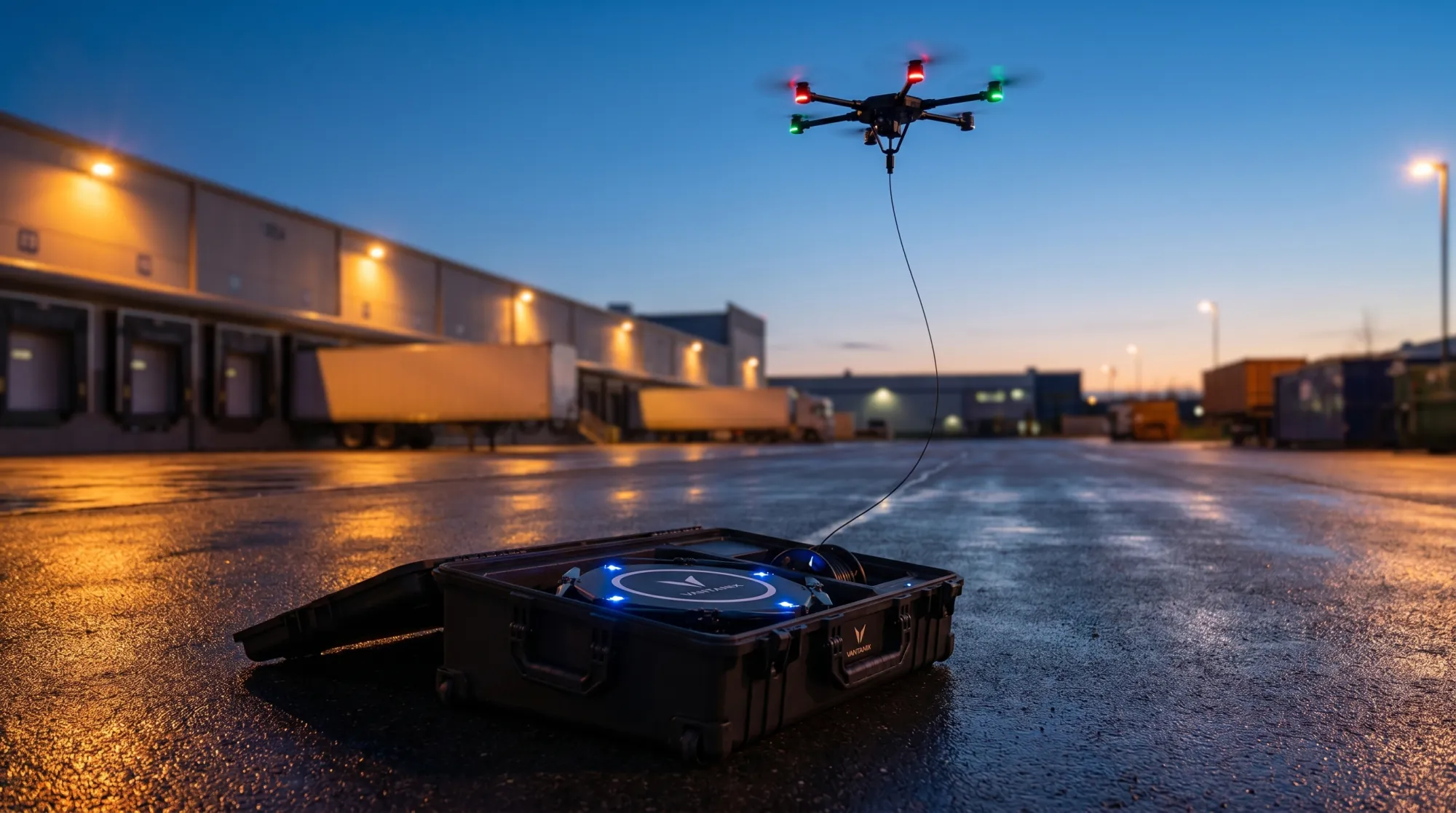
People meet the aircraft first. Operators fall for the box.
The Apus 100 ground station started life as a ruggedized transport case — the kind of mil-spec, gasket-sealed enclosure that survives being dropped off a truck — and became the heart of the system: power conversion, tether spool, docking, and weather protection in one unit that a single person can move and stand up in minutes.
The drone fits inside
The defining constraint was simple to say and hard to honor: the whole system travels as one case. The aircraft nests inside with the tether still attached — the line never disconnects, because the spool lives in the station. Open the lid, and the landing pad and spool are already connected to the aircraft sitting on them. Deployment isn't assembly; it's opening a box.
That constraint drove everything else. The airframe folds. The spool sits low to keep the case stable as the line pays out. Power conversion lives in the base where its weight helps instead of hurts. Every component earns its place twice: once in flight, once in transit.
Reeling is a flight-control problem
The spool is not a winch with a motor. As the aircraft climbs, line pays out under managed tension; as it descends, the line recovers at the same rate the sky gives it back. Too tight and the line fights the aircraft's ±1-meter station-keeping. Too slack and wind gets a grip on the catenary. The station manages this continuously, on its own — the operator flies the mission, not the string.
Docking runs the same philosophy in reverse. The line that connects the aircraft is also a guide home: recovery brings the aircraft down the wire it went up, to a pad whose location the system knows precisely, in conditions where a free-flying aircraft would be guessing.
Weather lives at ground level too
All-weather operation gets discussed as an aircraft property — and the airframe carries an IP55/IP56 design target for a reason. But the station takes the worse beating: it sits in standing water, blowing dust, and direct sun for the entire mission. Sealed when closed, drained and shielded when open, it's engineered so the limiting factor on a long watch is policy, not puddles.
The result is a system whose most impressive trick looks like nothing: one person, one case, one line — and eyes overhead from a cold start in minutes. Explore the system, or see how a deployment gets scoped.