
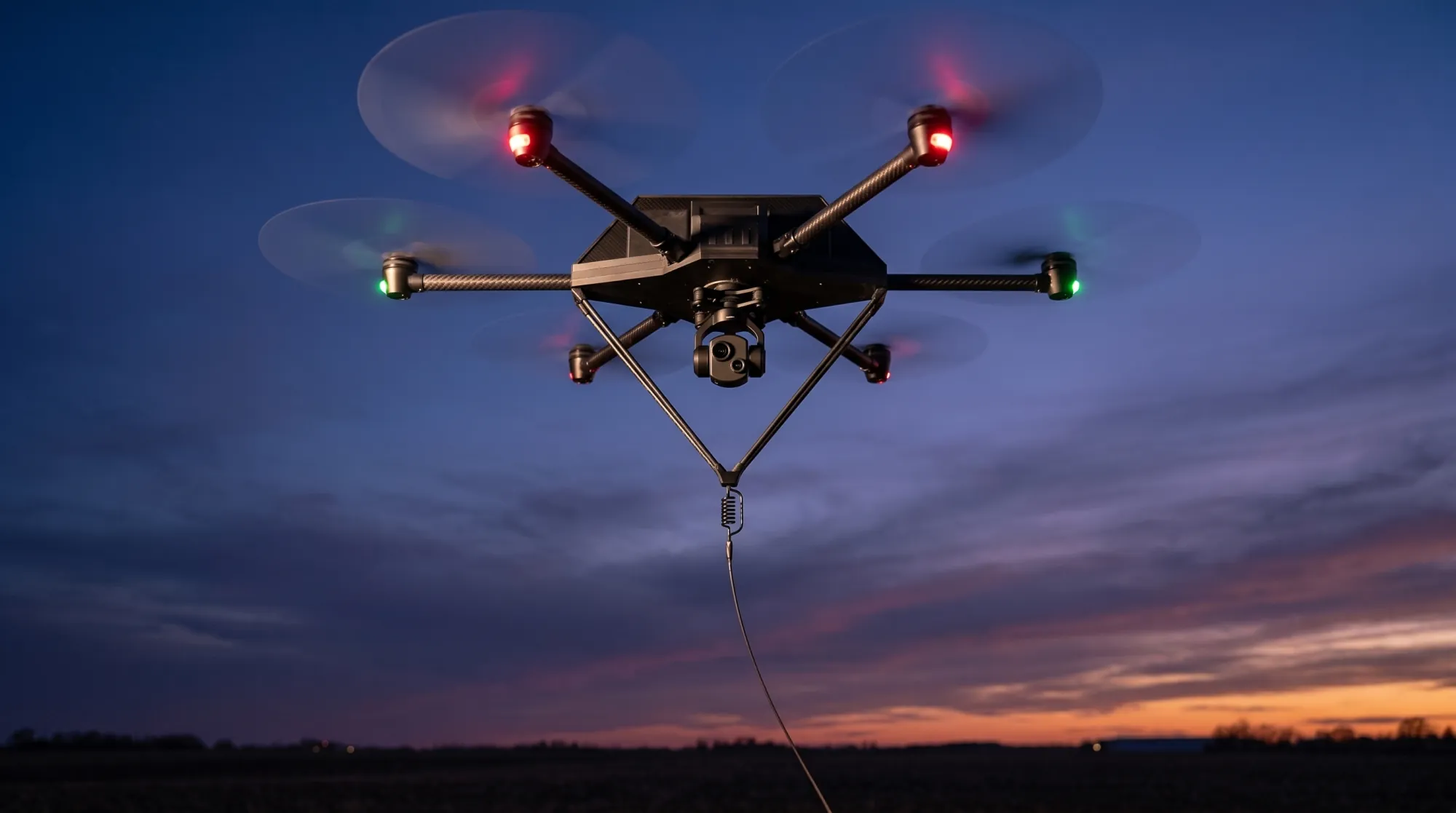
The tether looks like the simplest part of the system. It's the part everything else is built around.
One line runs from the ground station to the aircraft. Up that line: continuous power. Down that line: the full video feed and telemetry, over wired Ethernet. That single design decision quietly solves the three problems that limit every free-flying drone program — endurance, bandwidth, and emissions.
Power, without a landing
Endurance is the obvious win. With power generated at the ground and delivered up the line, the aircraft's batteries stop being the fuel tank and become what they should have been all along: a safety reserve. If the line is ever interrupted, onboard reserves bring the aircraft down in a controlled self-land. The battery's job is the landing, not the mission.
That's how a 15-pound aircraft holds a vantage point for 8+ hours: it never has to carry its own endurance.
A wire in a wireless world
The data story gets less attention and deserves more. Every free-flying drone shares unlicensed spectrum with everything else at your site — Wi-Fi, trackers, forklifts, phones. The busier the environment, the worse the feed, and the moments you most need clean video are exactly the moments the RF environment goes hostile.
The tether is wired Ethernet. The feed doesn't degrade because the venue filled up with phones. There's no downlink to intercept, and no broadcast announcing where your camera is or what it sees. For sites that take RF hygiene seriously — and for any operation that prefers not to advertise its eyes — a wire is not a compromise. It's the feature.
The unglamorous engineering
Most of the actual work in a tether system lives where nobody looks: line management. The spool lives inside the ground station and pays line out as the aircraft climbs, keeping tension controlled the whole way — slack enough not to fight the aircraft's station-keeping, tight enough that the line never gets away from it. Between the line and the airframe sits a damper, so gusts pulling on the tether are absorbed instead of transmitted into the aircraft — which is part of how it holds position within ±1 meter in standard wind.
None of this demos well. All of it is the difference between a tethered aircraft and an aircraft with a string on it.
See the full system, or the comparison against the alternatives.